

A source of pride and not shame for one’s nation is what national celebrations are all about. Of course there were massacre atrocities committed in the name of Australia and by colonizers, and violent cultural clashes between Indigenous groups and colonizers. And the way to deal with this is through collective responsibility1 and making material redress for these atrocities through ameliorating racial and ethnic disadvantage at the level of the state, even though largely today’s Caucasian Australians did not themselves commit these atrocities. Regarding national days of celebration, in and of themselves, there is no issue with celebrating the shared nation in which we co-inhabit regardless of race or ethnicity.
Whilst the Indigenous population was not politically organized into a modern day nation-state, the claim of Terra Nullius (’empty land’) was an erroneous legal fiction, as the High Court of Australia has subsequently found and reflects this truism that the continent was already occupied by an Indigenous population/populace, or more precisely – Indigenous populations (known as Mobs). Thus, whilst I totally understand where many Indigenous peoples, and many White socialists and liberals have been and are using the term First Nations1, I would like to propose the term First Peoples may, at times, be appropriate. This does not change nor negate the historical need for consensual biracial land-sharing of the continent in forging and negotiating treaties with each landed-language-unit of Indigenous territory upon the continent. This should have happened upon the arrival and landing of British peoples upon the continent, with first contact with each Mob (tribal unit).
For Australia, there is a very pressing need for a National Indigenous Day. I will also address the call for changing Australia Day to an allegedly more sensitive date such as January the 1st, the day when the Commonwealth was formed in 1901. January 26th 1788 is an important date for Caucasian Australians with the First Fleet docking at the Sydney Cove. Despairingly, there was the massacre of some Gamilaroi people also on January 26, but later on in 1838. Massacres of Indigenous peoples (6 or more deaths from violence) and violent clashes resulting in deaths of Indigenous people and Caucasian colonizers continued from 1781 to 1928 with violent Indigenous deaths far outnumbering violent deaths of Caucasian colonizers. This was due to an erroneous imperial and racial supremacist ideology of many colonizers along with the yielding of ‘technologically advanced’ weaponry such as muskets and other firearms. Furthermore, the forcible removal of Indigenous children from their families (the stolen generation) continued from 1910 – 1970s, as well as other brainlessly stupefying indignities such as slavery or indentured labour on cattle and sheep stations, in kitchens, homesteads shearing sheds or on the land between 1860s and the 1970s, and the withholding and denying of suffrage rights until 1984. In acknowledgement of an initial mistreatment of many Indigenous peoples, which is unfortunately still ongoing in some respects, many peoples, particularly many left-leaning liberals and socialists, recommend a date which is ‘historically neutral’ and or even ‘historically arbitrary’ for Australia Day, as preferable to January 26th. Instead of tearing down culture, which is connected with racial identity of Caucasian Australians, we should focus on doing things positive, that is to create in inaugurating a National Indigenous Day. I propose that this is a solution or going a long way to resolving or redressing the racial and cultural historical and present-day social and political contradictions. That way the day important particularly to White Australians, but also to all Aussies, could remain on the 26th as the day the continent was discovered by White people intending to establish a modern-day nation state, i.e. Australia.
The consent to racially co-inhabit the ‘Australian’ continent from Indigenous groups was lacking, perhaps partially because Aboriginal tribes were not united in a centralized political state – however this fact does not excuse nor vindicate colonizers’ actions. For the British who arrived on the continent’s shores, acting in good faith would have constituted the forging and negotiating of treaties with each of the territorial units of Indigenous First Peoples. Ergo the Aboriginal Indigenous identity should at least comprise the level of their population pre-existing Caucasian ‘settlement’, along with deploying other comprehensive social justice measures. This is to protect against ethnic cleansing. This population has been estimated to be somewhere in the vicinity of 3 million or more people.
The achievements of the Australian nation and all its peoples could be then celebrated on the 26th January. And our First Peoples, and their racial and cultural heritages, could be specifically celebrated on a date equally as important to all Australians, with a specific view to both memorialize and reproduce these heritages. This may be fitting with the post-colonial era in which we live? We need to actively show we take the well-being of Indigenous Peoples seriously, through careful community engagement, and political action(s). Their voices should not be quashed, and we need to stand up for First Peoples, and not attempt to silence them just because they are a minority group living in Australia today. They got here first, or they will say they always lived here. This gives the rationale for Land and Native Title Rights, as well as, of course, protected Indigenous heritage listed sites.
The Whites who migrated to Australia, at first contact with Indigenous peoples, founding a nation-state on the continent, were a large-scale agricultural and preliminary industrial racial and cultural population. Naturally as flow-on from this their racial and cultural identity was melded with a higher population than hunter-gather society. This is not a corollary that Whites were/are superior, just radically different. This gives rise to racially informed political-populations. Thus an ‘Anglo’ nation-state should co-exist with original Indigenous territories, with co-governance(s). The White population in Australia, and non-White persons who have migrated to Australia on the terms of the Australian nation-state, begun as (large-scale) agriculturalist and preliminary industrialist, no fully fledged industrialism. Three University of South Australia academics hold that 15 million people is a sustainable population for Australia. This means that non-Indigenous persons could reasonably be around 12 million based on this line of reasoning. Indigenous peoples on the continent may never have become large-scale agriculturalists and industrialists without White contact. But they were not living in primitive communism. Rather, they were efficient resource managers.
Non-Indigenous Australians may have been born here or immigrated here, and we should embrace a level of multiculturalism, plurality and tolerance, whilst preserving the autonomy of the ancient Indigenous culture(s) and the European descent culture(s), giving a strong bi-racial and so-called ‘mixed-race’ Indigenous-Caucasian (who embody both heritages) foundation integral to Australian identity, as well as a limited, but in good faith, new racial and cultural identities brought to Australian shores from people who are disadvantaged, hailing from geopolitically subordinated nationalities. This should happen with a level of memetic contagion to solicit a ‘rational cultural synthesis’ between the cultures, taking the best aspects of each and combining them to achieve what Nietzsche called the Super-Person (Übermensch)’; naturally, this happens internationally too, through globalizing technologies such as the internet.
Cultures inevitably intermix. All have their respective virtues and the point is to study them intricately to not only preserve cultural integrity and heritage, but to elicit cultural diversity and combining their best features too.
Indigenous cultures are more egalitarian, with greater social inclusivity, have an effective environmental ethic infused with their spirituality, and enjoyed a better work-life balance. These are awesome progressive traits that the liberal capitalist culture refuses to acknowledge in politically progressive enactment detracting from its authenticity.
What we need is for better self-governance of Indigenous Peoples (reflected in their U.N. right to self-determination), and socialist participatory norms for more direct economic and social decision-making for the Australian populace at large including Indigenous Peoples.
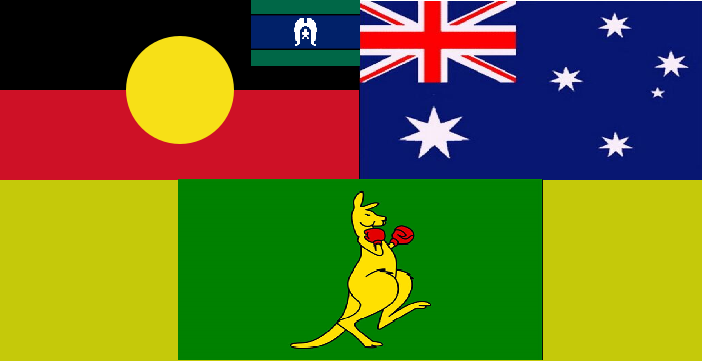
We should note that the name Australia for the nation state, and the national flag, are both colonial artefacts, which should be outgrown and surpassed in favour of a hybrid name and hybrid flag. Indigenous peoples could agree upon a name for the continent, through assembly organising, which could be hyphenated with the Anglo term Australia, appearing before and hyphenated with the term Australia. Non-Indigenous peoples, should also be careful of not over-breeding on traditional land if at the expense of ethnically cleansing Indigenous population(s), as this is certainly an insidious (neo)colonizing (ethnic cleansing) process. The Indigenous have and had really-existing knowledge of sustainable population; whilst I believe in some, more minimalist, form of industrial activity with a decrease in population to live in accord with the carrying capacity of the earth, we are yet to prove this can work in a really-existing political practice and praxis: really-existing feasibility is yet to be established, unlike the really-existing and politically proven Indigenous environmental ethic, which is also ancient in character.
A provisional idea for a hybrid flag is given below. My editing skills are quite poor, and intend to ameliorate the below flag so the Torrens Strait Islander Flag is the same size as the Union Jack. Also, the Kangaroo is not properly centered. Since we in Australia read from left to right, the Indigenous flag appears on the left congruent with the preoccupation of the continent of the Indigenous before the British colonial phenomenon – a spatial recognition of the temporal pre-occupation of the continent by the Indigenous before subsequent British Caucasian ‘migration’ (in establishing a nation-state). The flag also features a native Indigenous animal (the Kangaroo) with boxing gloves (a form of human technology). Your constrictive feedback and how it may be changed for this idea for a new national flag is welcomed.
As aforementioned and signposted above, another important avenue for social justice is the forging of treaties. The paramount exigencies for treaty-making exist. These should be between state governments and Indigenous traditional territories that are enclosed (or substantially enclosed) within these state government jurisdictions. Further, a treaty between all the Indigenous territories and peoples and the Commonwealth of Australia is pressing. The traditional Indigenous territories – comprising landed and sea political, language/dialect-variation, racial and ethnic units – never ceded their sovereign rights of the landed and sea political, language, racial and ethnic units. Furthermore, these traditional territories, before the arrival of British ‘settlers’ were subject to a form of native and traditional governance, albeit radically different from modernist European conceptions of governance and stewardship, however, no less legitimate nor inferior.
Inherent in the ideological positionings of this blog entry, is the political moralization of the nation-state. I believe the territorial nation-state system acts as bounding cultural, ethnic and racial identities, promoting diversity and belonging within large-scale social and economic complexity, and importantly acting as a break on centralised world-government. These, to be authentic, must become sites of proletariat power. See my blog post ‘Against Abolishing Nation-States as the Authentic Sites of Proletariat Power’: https://henrywilloughbyssocialjusticeblog.com/2020/10/17/against-abolishing-nation-states-as-the-authentic-sites-of-proletariat-power/
Another idea for a social justice mandate could be the enactment of the original Indigenous territories within the continent organized into a fourth tier of government negotiating political power(s) and practice(s) with local, state and national political power(s) and practice(s). These political units could be termed ‘Elders’ Councils’. I would personally like to see Indigenous women socially inducted as Elders along with Indigenous men. However, this is a decision for the Indigenous peoples on the continent. This fourth tier of government could be the subject of treaty negotiations to ‘reinstate’ the autonomous traditional territories which never ceded their
sovereignty/sovereignties.
Somewhat politically comforting is the individual’s surplus identity above racial / ethnic identity. I.e. racial and ethnic identity, whilst important to, are not totalising at the level of the individual person. Please see: https://henrywilloughbyssocialjusticeblog.com/2022/11/11/individualist-surplus-identity-above-race/
We, in Australia, could also be even more radically nationalist by becoming a republic, with acknowledgement of ‘the British colonial experience’ as an important part of European identity to White people. In point regarding the movement to become a republic nation-state, on the imperatives for Australian nationalism we should note in quoting Dr. James Saleam:
“Some of the colonial history is important to us. In the same way a genuine American would have some reverence for the genuine aspects to the British colonial experience. If you are a genuine Argentinian nationalist, you’d have some respect for the Spanish colonial experience. We Australians have to have some respect for the British colonial experience. Many things that were transferred to Australia became a part of the gestation pool for whom we later became.”
(Australia First Party, July 26 2017, “Jim Saleam on conservatism, the alt-right, and Australian nationalism”, 5:34 – 6:25, https://www.youtube.com/watch?v=Pbe7IEHBC18)
Similarly, instead of the reactionary idea of tearing down, damaging or defacing colonial artefacts and monuments, which is culturally destructive, racially and culturally disrespectful and morally reprehensible, we should do things positive and build statues and monuments of Indigenous peoples and their culture(s).
Additional ideas and feedback for comprehensive justice for Indigenous peoples, Caucasian / European-descent Australians, and all Australians, as equal national stakeholders, is welcomed.
Thank-you for reading.
Bibliography
Korff, J 26 February 2022, ‘Australia has a history of Aboriginal slavery’, Creative Spirits, https://www.creativespirits.info/aboriginalculture/history/australia-has-a-history-of-aboriginal-slavery#:~:text=Aboriginal%20slavery%20disguised%20as%20’Protectionism,the%20land%2C%20all%20across%20Australia.
Martin, P, Sutton, P and Ward, J 11 July 2017, ‘Why a population of, say, 15 million makes sense for Australia, The Conversation, https://theconversation.com/why-a-population-of-say-15-million-makes-sense-for-australia-78391
University of Wollongong Australia, 3 May 2021, ‘The First Australians grew to a population of millions, much more than previous estimates’, https://www.uow.edu.au/media/2021/the-first-australians-grew-to-a-population-of-millions-much-more-than-previous-estimates.php#:~:text=Previous%20estimates%20of%20Indigenous%20population,to%20more%20than%201%2C200%2C000%20people.
- What we need is collective responsibility, not collective apology of/from all White people or all Australians. Individuals apologising or the state apologising on the part of individuals who have not themselves perpetrated wrongdoings against Indigenous Australians just creates more race-hate and collective low self-esteem. It is material redress for historical exploitation, closing the gap of structural racial and cultural disadvantage, and restoring rightful Indigenous territorial governance(s); these are not mutually exclusive areas of/for redress. ↩︎
- Whilst I do like to use the term First Nations (Peoples) in some contexts, at times it may be projecting onto Indigenous peoples and their ancient territories a phenomenon conceptualised in a non hunter-gatherer society. The modern day nation was a subsequent political invention – subsequent to Indigenous tribal territorial governance. Of conceptual importance is that this Indigenous governance(s) is/are not inferior to the modern day nation as it now stands. Both should survive in a progressive synthesis. ↩︎
 Henry Willoughby's Social Justice Blog
One thought on “National Indigenous Day, Australia Day, ‘The Übermensch’, and Racial and Ethnic Justice”