

In South Australia, traction is being made at the level of the legislature for reproductive justice for women. A bill has been introduced to decriminalise abortion and situate abortion as a health issue instead of a criminal one. Human Services Minister Michelle Lensink introduced the bill to the Upper House.
Abortion is a fact of life with unreliable contraception methods, and unfortunately, the instances of sexual assault leading to pregnancy, as well as other instances of reproductive coercion. Even if a couple were ‘reckless’ in sexual activity, it still should be the woman’s choice as to whether she carries through with a pregnancy or decides to terminate it, as it is her body and thus her intrinsic life choice, where she can decide whether she would like a child or children in her life or not, at any given point in time. To raise a child is a huge and massive life-changing choice.
Abortion should be seen as unconditional healthcare and seen as a social good, not a necessary evil. This will reduce and eliminate abortion stigma1 which emanates from anti-choice propaganda, and archaic laws criminalising or illegalising abortion.
Experts say the fetus can only consciously experience pain at the 27 week mark of pregnancy2. However, the fetus still has not developed memory or preferences. Abortions performed after the 27 week mark of pregnancy would need an anaesthetic administered to the fetus, as long as this did no harm to the pregnant woman.
The apparent endowment of souls to material entities is deeply troublesome for adherents to anti-choice / ‘pro-life’. For many, the soul attaches at conception, and contains an individualistic blueprint as a unique personalist essence. For argumentation on the philosophical feasibility of an attaching, detachable, and re-attachable soul to human individuals, please see an extensively argued piece of mine:
In a nutshell, with religions such as Christianity and Islam, the preaching of an attachable, detaching, and re-attaching soul, we have pressurised, in a self-fulfilling philosophy, its coming into being through the collective unconscious. The collective unconscious is a Jungian term. Jung was a prominent and eminent psychiatrist, analytical psychologist, and philosopher. The collective unconscious is a term meaning and referring to:
“deep-seated, inherited personality structures—in Jung’s view a kind of “racial memory”—that reproduced age-old life patterns and forms of behavior. For Jung, the collective unconscious is composed of archetypes—basic situational, behavioral, and imaginative elements that provide the continuity of human existence. These are represented in condensed form, he argued, in mythology and religion”3
As theorised, the collective unconscious has ancestral imprinting in its makeup too:
“([I]n Jungian psychology) the part of the unconscious mind which is derived from ancestral memory and experience and is common to all humankind, as distinct from the individual’s unconscious“4
But, in spiritual interventions, the canny foresights of creationist Gods implemented a contingency fail-safe for the future event of a potential alienation of soul endowed fertilised egg / embryo or foetus wherein they may have otherwise suffered from the lack of latitude of a material body through which the soul can gain extra earthly enjoyment of the positive aspects to sentience—happiness, fulfillment, pleasure, ecstasy, rapture, wellbeing, positive meaning, enchantment etc. It was more a fail-safe against the potential for the offspring to be killed by evil force(s) before it could defend itself, i.e. its vulnerability, rather than the explicit foreseeing of the rise of a detachable soul—to prevent a life cut-short in that unjustifiable way. Theoretically speaking, these ‘creationist’ Gods, as polymath archetypes, may have themselves conceived both of evolution, and evolution as its own teleological end in itself particularly as emergence of complex highly sentient life-forms and their ecosystems, and of the big bang. This is a ‘big story’, disclosed by the machinations of the collective unconscious to which my conscious mind has been privy? Was there a God who spontaneously came into being through the surplus power of an infinite suffering? In a womb of mercury with a void filled with dark electric energy?
These kinds of philosophising might seem, prima facie, bizarre from a dogmatically narrow western perspective. Those finding it bizarre are those western background people without training in sufficient worldly reasoning. These narrow western perspectives are top-heavy on empiricism and ‘the scientism march’5. To offset this, studies in anthropology are vital, since they reveal a rich reservoir of radically ‘non-compliant’ and polyphasic meanings—radically non-western. Anthropology studies the myriad ways human nature expresses itself through individuals and culture. Anthropology gives you greater empathy for diverse identities of others and oneself, and for the human condition in general. For me personally, but not unlike many other scholars in the anthropological and other related academic fields, my polyphasic more intuitive Dionysian, more so than Apollonian, based knowledges come to fruition through a fusion of the anthropologist, philosopher, analytic psychologist, mystic and shaman facets of my consciousness!
I’ve studied in detail how many cultures experience truth in their own terms, radically different to western empiricism, and its monophasia—defined and developed in the succeeding paragraph. The task of the anthropologist in each adult person, is to take the best from all cultures to be studied, and letting go of the cultural mores (‘baggage’) that don’t serve people or humanity at large. In my neologism jargon, to undergo continually and continually select for—a rational cultural synthesis, is needed. Before moving ahead, it’s obligatory to define and contrast conceptual frameworks of an intellectual dichotomy device—monophasia ‘versus’ polyphasia.
Monophasic culture “is primarily concerned with tracking, cognizing and responding to external events in the so-called waking state”6. Furthermore, “western societies…foreground monophasic or ordinary states of awareness based on rationality and empiricism”7. In contrast “[p]olyphasic culture refers “to non-ordinary consciousness; dreams, visionary and mystical states, hallucinations, intuition, meditation, trance states, self-hypnosis, and near death experiences”8. In a scholarly and intellectual erring, “[t]he interpretive power of scientism and technology has either relegated or dismissed polyphasic states to the realm of irrationality and fairy tales”9. A part of this is the cursory, ironically unscientific, attempted relegation of the existence of non-local mind as metaphysical unreality; non-local mind can be defined as:
“the ability of one mind to influence another mind from a distance, or knowing something which is beyond the grasp of sensory perception…[and]…is referred to as intuition, premonitions, déjà vu, telepathy, ‘gut feeling’, precognition, distance healing, remote sensing, extra sensory perception (ESP), psyhokinesis and clairvoyance”10.
“There have been approximately 900 studies conducted over the last sixty years on non-local ways of knowing”11.
From the practices of witchcraft by the Azande12, the divination dancing of the Faqir/Dervish/Sufi13, to the subversive and resistant meaning-making and meaning-appropriations of film by Papua New Guinean informants14, we see the indefatigable sheer richness and varied meanings across the localised and globalised contexts and their overlaps.
Perhaps the imaginary power of a ‘third eye’ is being engaged with archaic knowledge based on placing individual and species essences? Is this a result of reconciling information gleaned from the conscious mind with the unconscious mind disclosures? On this, it’s now timely apt to give definitional scaffolding, herein, to the conscious mind of individuals:
“Although the concept has many antecedents in Western philosophy, it was Signmund FREUD who first systematically sought to distinguish between consciousness, the preconscious (denoting information available but not immediately present in consciousness) and the unconscious (a broad realm of the psyche hidden from conscious processes). Although Freud’s thinking on the subject evolved considerably during the course of his work, he maintained that what divided the conscious from the unconscious was a mechanism of repression that blocked socially unacceptable impulses, wishes, and traumatic experiences from conscious realization. Nonetheless, he argued that the relationship between consciousness and the unconscious was porous and dynamic: the unconscious shaped behavior outside of conscious intention. Freudian “slips” and TRANSFERENCE are examples. Although the manifestations of the unconscious opened it to study, Freud was highly sensitive to the processes of condensation and displacement—forms of camouflage and distortion—that repression imposes on unconscious material. Much of Freud’s work in this area derived from his study of dreams, where the barriers between the conscious and unconscious were lower than in waking life. In Freud’s later work, the term unconscious is largely superseded by the notion of the ID—an element of the tripartite division of the psyche into id, ego, and superego.”15
So, now we have covered the above Freudian and Jungian concepts, let’s get to the most pertinent question of this blog post: what might a workable (creationist) contingency look like in substantial resolution of the potential problem of denying the freedom of a soul to enjoy a material body in the event of an abortion?
For an aborted fertilised material entity—an embryo or foetus, in this world, the soul immediately detaches and reattaches off-world; it is then given a surrogate womb maintaining perfect homeostatic health; as surrogates to our on-world / on-cosmos genetic parents, care for infants is carried through by altruistic aliens, guardian angels and plant gods, who currently do a far better job at child rearing than any parents than any and every parent on this world!
There is a tax on the being of the genetic parents in this world, to be paid as energy off-world, to a parallel universe not for the purpose of compensation or a punitive deterrent, but for extra wellbeing of the progeny.
This is a partial corrective to Christian and Islamic metaphysics, with a culturally inclusivity of magical ‘alternatives’ to these doctrines, that have been victim to an unjust unduly hegemonic sidelining. These predating organised religious doctrine(s), as animist and shamanist spiritual ways of being-in-the-world16 need a resurrection to milk them of their humanising potential(s) and their contribution to the human project, generally. On this need, see professors Henneberg and Saniotis wonderful book chapter 17 thereon.
My anthropologically and psychologically derived and informed positionings is the philosophical synthesis and fusing of collective unconscious forces with polymath creationist, and protectionist with foresight, Gods. However, let us further look at and canvas the ethics around personhood from a purely materialist perspective, as this does work if people are unwilling to entertain what may seem, above, prima facie, a radical position on souls and protectionist creationist, yet ontologically incomplete and not omnipotent, Gods. Oddly, we arrive at the same moral conclusion: pro-choice rights for women:
Firstly, if the Christian God is omnipotent (all-powerful) then why did it create the possibility of an abortive murder of the soul? This would be tarnishing God’s grace with a psychopathic trait.
As a gendered position, I hold that being a mother (or motherhood), is only truly met at birth when the baby is no longer a part of the pregnant woman’s body.
There is also the argument oft parroted by anti-abortion activists that a woman who terminates a pregnancy will be psychologically traumatized. But why? Why would a woman feel any guilt for terminating a pregnancy of a fetus which has not developed memory or preferences and is still a part of the pregnant woman’s body and not a separate living individual/being – not yet a person.
We must prioritise the lives of already extant and existent pain-perceiving sentient beings who have developed preferences and are capable of acute emotional suffering – aka women, over that of fetuses who are not yet babies.
Singer (1995, https://www.utilitarian.net/singer/by/1995—-03.htm), in his utilitarian ethics, argues that to be human is to be self-aware and conscious, and I would add to this, capable of consciously experiencing or perceiving pain, and a separate individual no longer a part of the pregnant woman’s body. Thus, we should assign personhood rights at birth. Fetuses, up until birth, are not human, yet.
We must combat abortion stigma. Anti-choice, anti-abortion activists are not approaching the issue from a rational standpoint, and instead employ and deploy dogmatic superstition in the face of scientific evidence. There is no empirical evidence that any living creature has a metaphysical soul whether sentient, non-sentient or not-yet sentient. The archaic religious dogma that fetuses have souls, encroaches on the rightful liberty of women who are sentient beings with personhood.
It is a crying shame that religious conservative women would vie for the erosion or curtailing of just reproductive rights of women, subscribing to patriarchal monotheistic religious dogma such as that in some Christian sects. It’s alienating when women do not subscribe to truly feminist causes. But worse when men, especially those afforded with high degrees of economic privilege, subscribe to anti-choice sentiments. Second wave feminists had it right, and we should revive reproductive rights as a truly feminist cause, which is entirely rational and ethical, and seek to educate people of facts regarding fetuses and the stages of their development. Feminism is a progressive social force, and there is a dire need for a new progressive and inclusive wave of feminism, and masculine pro-feminism, throughout the world, to combat patriarchy at the level of social institutions, seeking law reforms.
Anti-abortion sentiment is two pronged in its misconception(s), which are often not entirely mutually exclusive:
- It is based on a lack of informed empathy for women;
- It is not based on scientific understandings on sentience, personhood, and/or is grounded in superstition.
The bottom line, is that anti-choice, when propagated by men, is patriarchal as it erodes the just liberty of women. In this instance, proper empathy for women and the baby – becoming one at birth – comes from technical and rationally materialist understandings, integral to formulating just and workable ethics on the matter.
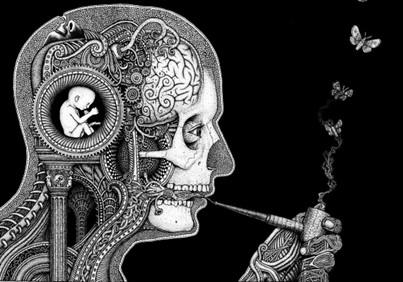
https://twitter.com/webmasterdave/status/885857237511622660/photo/1
Thanks to David Pearce for sharing on Twitter.
For me, the above work of art depicts ‘The Pro-feminist, Pro-Choice, Masculinist Philosopher: Caring in the Mind’! It is in awe of the capacity for women to carry a foetus in the womb as a part of her body, and truthfully, simultaneously envious of this remarkable biosocial feat.
The foetus is a part of the woman’s body, giving pro-choice rights to women. This image depicts the masculine rationalist contemplating of the foetus as a part of a/the woman’s body in envy of (and ensuing masculinist bio-genetic-alienation from) the woman’s unique and exceptional capacity to carry a foetus as a part of her body: (acknowledging) the woman and the man (or non-binary) begin as a foetus in circular dialectics – all protecting and nurturing personhood through pro-choice ethics. There is the rightful masculinist fascination that life starts within a woman.
What of contractual pregnancy?
Let us set up an abstract thought experiment hereon, and progress through it. Could a man and a woman agree, say, in a monogamous sexual relationship, to use birth control methods, expressly stipulating they are both in agreement for not having a child or another child together, in a written and signed contract? You both want to engage in ejaculatory sex, but stipulate the intention not to procure a pregnancy, utilising birth control method(s), in such a written contract. Perhaps such a contract could be setup, however, there are some serious problems latent in such a contract. Let us explore some potential legal remedies given an ensuing breach of the contract through a subsequent withdrawing of a legitimate consent to pregnancy.
Specific performance18:
- “An equitable remedy to compel the execution in specie (in its own form) of a contract which requires some definite thing to be done before the transaction is complete and the parties’ rights are settled and defined in the manner intended…;
- In its strict or technical sense, the enforcing of an executory contract by compelling the execution of an assurance to complete it…;
- An order applied to an executed contract requiring the defendant to perform his or her contractual obligation…;
Specific performance is available, subject to discretionary factors, where the common law does not provide a remedy, or where the common law is inadequate.”
Specific performance would mean an abortion in this instance. However, specific performance of the term of contract in this instance, falls short of morally operable because it is intrusive to a woman’s body to contractually enforce an abortion as such.
Damages might be more feasible, prima facie? I don’t like enforcement of damages as a remedy for breach of contract concerning pregnancy and birth control, as it is potentially setting up an antagonistic relationship between the genetic parents at the outset. It is putting sexual gratification above a potential future offspring’s wellbeing. Thus, the rightful reproduction power of men lies in the choice for abstinence from having ejaculatory sex with a woman.
Conversely, a voluntary written contract between a woman and a man, that in the event of a pregnancy, that the woman will reasonably take measures to follow through with pregnancy til birth, would not be invasive to a woman’s physiology nor psychology; a subsequent breach may give rise to damages paid to the man wrongfully dispossessed of a future fatherhood in such a way. In such a contract, the element of force is absent, yet might frame a relationship as founded upon mistrust.
Concluding with a paraphrasing reiteration—attempting to force a woman to abort/terminate or carry through with a pregnancy is a form of reproductive coercion, as it is intrusive of and an interference with women’s bodily autonomy. Men’s rightful reproductive power lies in withholding the seed unless wanting to become a father! See:
I would personally like to see a world without abortion and not trampling on the legitimate rights of women; equally, whilst there is abortion, I would like to see the world without abortion stigma.
Post Script: Perhaps the outsourcing of a womb environment to a technological surrogate, outside of a woman’s body, delivering healthy development of foetuses and babies will make abortion entirely redundant? That kind of technology, seems very far into the distance of our future?
Post Post Script: I don’t have all the answers on this matter, and my synthesis and ideas need dialectical action with other scholars on this area of philosophy intersecting with gender studies and biological and personhood science. As an alternative to the alleged metaphysical soul-attaching at conception, I have written on feminist-materialist ethics on abortion, as whole or at least partial alternative to the above writing and synthesis on this very complex and intellectually and emotionally delicate matter. I leave it open to the engaging scholarship of others: is there a materialist exceptionalism to the putative rise of a severable soul attaching at conception, in defiance of, diverging from and circumventing this emerged/ing religico-evolutionary phenomena therein? I allege, the more deeply we think about this, the more a nuanced sense of justice will eventuate and be augmented.
Reference List
Butt, P 2004, Butterworths Concise Australian Legal Dictionary, 3rd edn, LexisNexis Butterworths, Chatswood.
Calhoun, C (ed.) 2002, Dictionary of the Social Sciences, Oxford University Press, New York.
Eternalised: In Pursuit of Meaning, ‘Dasein and Being-in-the-world – Heidegger’, last accessed 28 January 2021, https://eternalisedofficial.com/2021/01/28/dasein-being-in-the-world/#:~:text=in%2Dthe%2Dworld-,Being%2Din%2Dthe%2Dworld,to%20fulfil%20in%20this%20world.
Evans-Pritchard, E 1976, Witchcraft, Oracles and Magic among the Azande, Clarendon Press, Oxford.
Henneberg, M and Saniotis, A 2016, The Dynamic Human, Bentham Science Publishers, Sharjah
Kulich, D and Wilson, M 1994, ‘Rambo’s Wife Saves the Day: Subjugating the Gaze and Subverting the Narrative in a Papua New Guinean Swamp’, Visual Anthropology Review, vol. 10, no. 2, pp. 1-13.
Kumar, A, Hessini, L and Mitchell, E 2009, ‘Conceptualising abortion stigma’, Culture, Health and Sexuality, vol. 11, no. 6.
Laughlin, C 1997, ‘The Mystical Brain: Biogenetic Structural Studies in the Anthropology of Religion’.
Miller, S 2016, (last updated 4 August 2022), ‘Do Fetuses Feel Pain? What the Science Says’, Live Science, last accessed 26 January 2025, https://www.livescience.com/54774-fetal-pain-anesthesia.html
Oxford Languages Dictionary, ‘collective unconscious’, last accessed 26 January 2025, https://www.google.com/search?q=define+the+collective+unconscious&rlz=1C1GIGM_enAU511AU514&oq=define+the+collective+unconscious&aqs=chrome..69i57.4927j0j1&sourceid=chrome&ie=UTF-8
Radin, D 2008, ‘Testing nonlocal observation as a source of intuitive knowledge, Explore, vol. 4, no. 1, pp. 25-35. http://dx.doi.org/10.1016/j.explore.2007.11.001
Saniotis, A February 2002, Sacred Worlds: An Analysis of Mystical Mastery of North Indian Faqirs, A Dissertation Submitted for the Degree of Doctor of Philosophy, Adelaide University, Department of Anthropology, Faculty of Humanities and Social Sciences.
Singer (1995, https://www.utilitarian.net/singer/by/1995—-03.htm)
- Kumar, A, Hessini, L and Mitchell, E 2009, ‘Conceptualising abortion stigma’, Culture, Health and Sexuality, vol. 11, no. 6, pp. 625-639. ↩︎
- Miller 2016, https://www.livescience.com/54774-fetal-pain-anesthesia.html ↩︎
- Calhoun, C (ed) 2002, Dictionary of the Social Sciences, Oxford University Press, New York, p. 78. ↩︎
- By the Oxford Languages Dictionary, the collective unconscious is (in Jungian psychology) the part of the unconscious mind which is derived from ancestral memory and experience and is common to all humankind, as distinct from the individual’s unconscious”, https://www.google.com/search?q=define+the+collective+unconscious&rlz=1C1GIGM_enAU511AU514&oq=define+the+collective+unconscious&aqs=chrome..69i57.4927j0j1&sourceid=chrome&ie=UTF-8 ↩︎
- Henneberg, M and Saniotis, A 2016, The Dynamic Human, Bentham Science Publishers, Sharjah, pp. 102-105. ↩︎
- Laughlin, C 1997, ‘The Mystical Brain: Biogenetic Structural Studies in the Anthropology of Religion’. ↩︎
- Henneberg, M and Saniotis, A 2016, The Dynamic Human, Bentham Science Publishers, Sharjah, p. 103. ↩︎
- Ibid, p. 102. ↩︎
- Ibid, p. 103. ↩︎
- Ibid, p. 107. ↩︎
- Ibid, p. 108. See also Radin, D 2008, ‘Testing nonlocal observation as a source of intuitive knowledge, Explore, vol. 4, no. 1, pp. 25-35. http://dx.doi.org/10.1016/j.explore.2007.11.001 ↩︎
- See Evans-Pritchard, E 1976, Witchcraft, Oracles and Magic among the Azande, Clarendon Press, Oxford. ↩︎
- See Saniotis, A February 2002, Sacred Worlds: An Analysis of Mystical Mastery of North Indian Faqirs, A Dissertation Submitted for the Degree of Doctor of Philosophy, Adelaide University, Department of Anthropology, Faculty of Humanities and Social Sciences. ↩︎
- Kulich and Wilson found that their anthropological informants ‘dislodge[d] the filmic narrative with parallel narratives of their own, fragmenting and then reassembling the film to satisfy their desire and their gaze’: Kulich, D and Wilson, M 1994, ‘Rambo’s Wife Saves the Day: Subjugating the Gaze and Subverting the Narrative in a Papua New Guinean Swamp’, Visual Anthropology Review, vol. 10, no. 2, p. 10. ↩︎
- Calhoun, C (ed.) 2002, Dictionary of the Social Sciences, Oxford University Press, New York, p. 495. ↩︎
- Eternalised: In Pursuit of Meaning, ‘Dasein and Being-in-the-world – Heidegger’, last accessed 28 January 2021, https://eternalisedofficial.com/2021/01/28/dasein-being-in-the-world/#:~:text=in%2Dthe%2Dworld-,Being%2Din%2Dthe%2Dworld,to%20fulfil%20in%20this%20world. ↩︎
- See ‘Chapter 9: Other Ways of Knowing: Retrieving the Shaman in Us’ in The Dynamic Human, Bentham Science Publishers, Sharjah, pp. 102-138. ↩︎
- Butt, P 2004, Butterworths Concise Australian Legal Dictionary, 3rd edn, LexisNexis Butterworths, Chatswood, p. 404. ↩︎
 Henry Willoughby's Social Justice Blog